SEO articles
Technical SEO, content and rankings, from real projects.
Google Ads articles
Search, Shopping and Performance Max campaigns that pay for themselves.
Emailing articles
Cold email, deliverability and sequences that get replies.
GEO articles
Generative engine optimization: what is proven, what is not.
-

Semantic SEO: How to Write for Meaning, Not Just Keywords
Read the article: Semantic SEO: How to Write for Meaning, Not Just KeywordsFor years, SEO followed a simple formula: find a keyword, repeat it enough times on a page, and Google would rank you. That formula stopped working a long time ago,…
-

Title Tags and Meta Descriptions: How to Write Them for Clicks and Rankings
Read the article: Title Tags and Meta Descriptions: How to Write Them for Clicks and RankingsYour website might have the best content in your industry, but if nobody clicks on it in search results, it might as well not exist. Title tags and meta descriptions…
-

Competitive Keyword Analysis: How to Find What Your Competitors Rank For (and Steal Their Best Ideas)
Read the article: Competitive Keyword Analysis: How to Find What Your Competitors Rank For (and Steal Their Best Ideas)There is a shortcut in SEO that is not actually a shortcut at all, but a proven methodology used by every serious agency and in-house team. Instead of starting your…
-

Keyword Cannibalization: The SEO Myth That Sells Audits (and What Google Actually Says)
Read the article: Keyword Cannibalization: The SEO Myth That Sells Audits (and What Google Actually Says)Search any SEO blog for “keyword cannibalization” and you will find article after article painting a terrifying picture: your pages are fighting each other, your rankings are collapsing, you need…
-

Updating Old Content: The Highest-ROI SEO Activity Nobody Does
Read the article: Updating Old Content: The Highest-ROI SEO Activity Nobody DoesThere is a paradox at the heart of content marketing. Most businesses pour nearly all their content budget into creating new articles, new pages, new blog posts. They treat content…
-

How Often Should You Publish Blog Posts? The Data-Driven Answer for 2026
Read the article: How Often Should You Publish Blog Posts? The Data-Driven Answer for 2026Every business owner who starts a blog eventually asks the same question: how often should I publish? The internet is full of contradictory advice. Some experts say you need to…
-

E-E-A-T in 2026: What Google Expects From Your Website and How to Deliver It
Read the article: E-E-A-T in 2026: What Google Expects From Your Website and How to Deliver ItE-E-A-T is arguably the most important concept in SEO that is not technically a ranking factor. Google has confirmed explicitly that there is no “E-E-A-T score” and that its ranking…
-

How to Write Content That Google Loves and Humans Actually Read
Read the article: How to Write Content That Google Loves and Humans Actually ReadThere is a paradox at the heart of modern SEO content. Google tells you to write for humans first, not for search engines. Yet the entire reason you are writing…
-

Technical SEO Demystified: What Business Owners Need to Know Without the Jargon
Read the article: Technical SEO Demystified: What Business Owners Need to Know Without the JargonTechnical SEO is the part of search engine optimization that makes most business owners’ eyes glaze over. It sounds complicated, it involves code and server configurations, and the terminology alone…
-

On-Page SEO: The Complete Checklist for Every Page on Your Website
Read the article: On-Page SEO: The Complete Checklist for Every Page on Your WebsiteOn-page SEO is everything you control directly on your web pages to help search engines understand, index, and rank your content. Unlike off-page SEO (backlinks and brand mentions) or technical…
-

Long-Tail Keywords: How to Find Low-Competition Terms That Actually Convert
Read the article: Long-Tail Keywords: How to Find Low-Competition Terms That Actually ConvertYou want your website to rank on Google. So you target the obvious keywords, the short, high-volume terms that seem like the biggest prize. “SEO.” “Web design.” “Project management software.”…
-

Search Intent Explained: Why Choosing the Right Keywords Is Not Enough
Read the article: Search Intent Explained: Why Choosing the Right Keywords Is Not EnoughTwo websites target the exact same keyword. One ranks on the first page; the other is buried on page five. Both have good content. Both have decent backlinks. Both are…


-

Google Ads Assets: Sitelinks, Callouts, Images, Lead Forms, Price and Promotions
Read the article: Google Ads Assets: Sitelinks, Callouts, Images, Lead Forms, Price and PromotionsIntroduction: the cheapest CTR lift in Google Ads Most paid search audits begin with the same finding. The headlines are decent, the keyword list is acceptable, the landing page does…
-

How to Create and Set Up a Google Ads Account in 2026: Complete Guide
Read the article: How to Create and Set Up a Google Ads Account in 2026: Complete GuideSetting up a Google Ads account in 2026 is not the 20-minute exercise the platform’s onboarding wizard suggests. The interface has been rebuilt three times since 2023, Performance Max is…
-

Google Ads Account Architecture: Campaigns, Ad Groups, Naming Conventions and Labels
Read the article: Google Ads Account Architecture: Campaigns, Ad Groups, Naming Conventions and LabelsIntroduction: the foundation of sustained profitability A disorganized Google Ads account is like a kitchen without a cutting board: you see everything that needs doing, but nothing lands in its…
-

Google Ads Campaign Types: Complete Comparison and Decision Tree
Read the article: Google Ads Campaign Types: Complete Comparison and Decision TreeGoogle Ads exposes ten distinct campaign types in 2026, and the gap between picking the right one and picking the wrong one is the gap between an account that compounds…
-

Google Ads Editor: Bulk Editing, Import/Export and Multi-Account Workflows
Read the article: Google Ads Editor: Bulk Editing, Import/Export and Multi-Account WorkflowsGoogle Ads Editor is the desktop application Google ships for free, and it is the difference between an account you can manage and an account that manages you. The web…


-

The accessibility directive does not mention your emails
Read the article: The accessibility directive does not mention your emailsSince June 2025 you have been told that your emails must be accessible, and that the European directive requires it. We have read the directive. The word “email” does not…
-

Dark mode is documented only at Apple
Read the article: Dark mode is documented only at AppleOne day a client writes to say your newsletter is unreadable. Screenshot attached: dark background, dark text, a logo cut out inside a white square. You go looking for the…
-

Gmail does not block your images, it steps in
Read the article: Gmail does not block your images, it steps in“Images are blocked by default.” That sentence is repeated in every email marketing guide, and it is true at one operator out of two. At the other, something quite different…
-

Your preheader has been replaced by a summary
Read the article: Your preheader has been replaced by a summaryYou spent time on your preheader. That line of text following the subject in the message list, which guides present as the second subject line, and on which part of…
-

Some of your clicks were never made by anyone
Read the article: Some of your clicks were never made by anyoneYou send a campaign. Thirty seconds later the dashboard already shows clicks. Nobody has read anything. Those are machines, and their vendor documents it. What Microsoft does to your links…
-

Three operators, three ways of telling you
Read the article: Three operators, three ways of telling youA recipient clicks “report spam”. That gesture decides your fate, and it happens without you knowing anything about it. Unless you are enrolled in a feedback loop. All three major…
-

Spamhaus does not sell its way out
Read the article: Spamhaus does not sell its way outOne morning your messages stop going out. The sending log repeats the same line, and it contains a name: Spamhaus. A predictable sequence follows. Someone searches for “get IP removed…
-

The dedicated IP you are sold will never warm up
Read the article: The dedicated IP you are sold will never warm upThe day you sign with a sending provider, you will be offered a dedicated IP address. The price is modest, the argument simple: your reputation will be your own. That…
-

One subdomain per stream, on one condition nobody quotes
Read the article: One subdomain per stream, on one condition nobody quotesThe recommendation is everywhere: separate your sending streams by subdomain. One for invoices, one for newsletters, one for prospecting. It has a primary source, which is rare enough to be…
-

Two thousand messages a day, and that is all
Read the article: Two thousand messages a day, and that is allThere is a conversation that happens every year in every company, and it always starts the same way: “how many can we send from our work mailbox?” The answer is…
-

No warm-up schedule has ever been published
Read the article: No warm-up schedule has ever been publishedLook for a warm-up schedule. You will find dozens, all different, all presented with the same confidence. Day 1, fifty messages. Day 2, one hundred. Day 3, two hundred and…
-

A rejected message tells you exactly why
Read the article: A rejected message tells you exactly whyA rejected message answers you. It tells you why, with a precision you will find in no dashboard, and it tells you for free. Almost nobody reads it. People look…
-

Meta Ads Not Performing? A Real Diagnostic Method
Read the article: Meta Ads Not Performing? A Real Diagnostic MethodYour Meta ads are not performing and you have no idea why. So you do what everyone does. You change the audience. Then you change the budget. Then you pause…
-

Meta Ad Policies and Account Bans: Avoid and Recover
Read the article: Meta Ad Policies and Account Bans: Avoid and RecoverFew emails ruin a morning faster than «Your ad account has been disabled». One moment your campaigns are spending, the next your access is gone and the dashboard shows a…
-

Meta Lead Generation for B2B: The Honest Guide
Read the article: Meta Lead Generation for B2B: The Honest GuideThere is a persistent story in B2B marketing that Facebook and Instagram are where you sell shoes and supplements, not enterprise software or industrial equipment. The story is wrong, and…
-

Advantage+ Shopping (ASC): The E-commerce Guide
Read the article: Advantage+ Shopping (ASC): The E-commerce GuideAdvantage+ Shopping Campaigns, ASC for short, stopped being an experiment a long time ago. On Meta s Q4 2024 earnings call, CFO Susan Li said the product had passed a…
-

Scaling Meta Ads Without Breaking Performance
Read the article: Scaling Meta Ads Without Breaking PerformanceYou found a campaign that works. The cost per result is where you want it, the return holds, and the obvious next move is to pour more money in. Then…
-

Meta Learning Phase: How It Really Works
Read the article: Meta Learning Phase: How It Really WorksThe learning phase is the most misunderstood mechanic in Meta advertising, and that misunderstanding costs real money. Half of what circulates about it on forums and agency blogs is folklore:…
-

Meta Bid Strategies: Lowest Cost vs Cost Cap vs ROAS
Read the article: Meta Bid Strategies: Lowest Cost vs Cost Cap vs ROASMost advertisers pick a bid strategy the way they pick a Netflix show: by guessing, then second guessing. The folklore around Meta bidding is thick and mostly wrong. Bid cap…
-
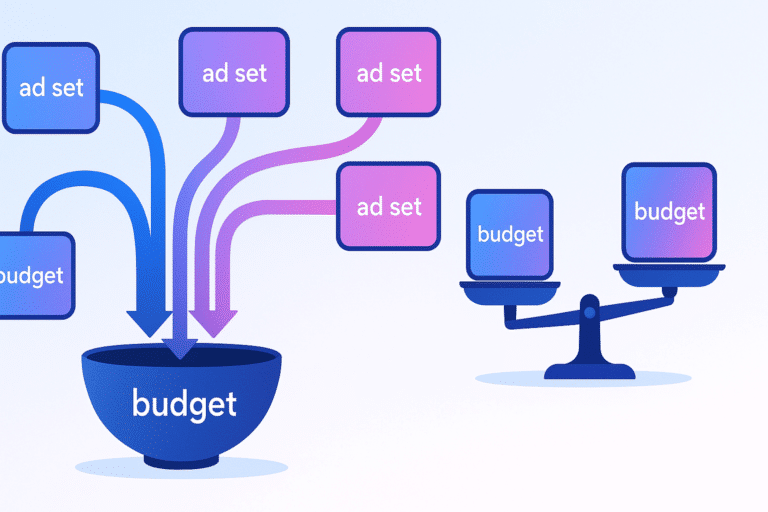
CBO vs ABO on Meta: Which Budget Wins
Read the article: CBO vs ABO on Meta: Which Budget WinsOpen any Meta ads forum and you will read the same verdict, repeated like a law of physics: CBO is better, ABO is dead, let the algorithm decide. That verdict…
-

Meta Ad Copywriting: What Actually Converts
Read the article: Meta Ad Copywriting: What Actually ConvertsMost advice about Meta ad copy is recycled folklore. People repeat that short copy always wins, that nobody reads, that the algorithm now writes everything for you. None of it…
-

Meta Creative Testing: Find Winning Ads
Read the article: Meta Creative Testing: Find Winning AdsCreative is now the lever that decides whether you win or lose on Meta. The targeting moved into the machine, the auction sorts itself out, and what is left in…
-

UGC for Meta Ads: Why It Works and How to Produce It
Read the article: UGC for Meta Ads: Why It Works and How to Produce ItUser-generated content has become the default creative format for performance advertisers on Meta, and for good reason. Ads that look like a real person filmed them on a phone consistently…
-

Meta Ad Formats: Which One, When, and Why
Read the article: Meta Ad Formats: Which One, When, and WhyMost advertisers pick a Meta ad format out of habit, not strategy. They run single images because they always have, or they chase Reels because someone said video is the…


-

GEO: the five studies that could prove us wrong
Read the article: GEO: the five studies that could prove us wrongWe argue that most of what the market calls GEO is unproven. Here are the five strongest published works that say the opposite, and the conditions that would change our…
-

Test GEO on your own site in 30 days: our protocol
Read the article: Test GEO on your own site in 30 days: our protocolNobody can tell you whether GEO works in the abstract. You can measure it on your own site, in thirty days, with a control group and repeated measurements.
-

What GEO really costs, and what we refuse to sell
Read the article: What GEO really costs, and what we refuse to sell55 percent of marketers now have a GEO budget line. Not one practitioner surveyed disclosed an amount. Here are our prices, and the list of what we refuse to bill…
-

Are the publisher apocalypse numbers honest?
Read the article: Are the publisher apocalypse numbers honest?Minus 58 percent, minus 70 percent, or minus 10 percent? Each camp measures a different thing and uses the same word. How to read the numbers on traffic decline.
-

Sixteen percent of the sources AI cites are themselves written by AI
Read the article: Sixteen percent of the sources AI cites are themselves written by AIAn audit of 712 real queries across four engines measures that roughly one cited source in six is generated content. GEO mechanically rewards what degrades the corpus.
-

Manipulating AI answers: what works in the lab, what holds up in production
Read the article: Manipulating AI answers: what works in the lab, what holds up in productionInjection attacks work on isolated systems. In production, a testbed of 1,000 black-hat sites measures 99.78 percent neutralization. The real weakness is somewhere else entirely.
-

The sources AI prefers are not yours
Read the article: The sources AI prefers are not yoursGenerative engines systematically favor third-party sources over the content you publish on your own site. Your GEO budget is therefore aimed at the wrong place.
-

Global brands 73 percent, niche brands 11 percent: GEO democratizes nothing
Read the article: Global brands 73 percent, niche brands 11 percent: GEO democratizes nothingAcross 100,000 answers and 100 brands, three visibility tiers appear from the very first query. A small player does not start at zero. It starts at 11 percent.
-

Position bias: your content is not losing on substance, it is losing in the middle
Read the article: Position bias: your content is not losing on substance, it is losing in the middleA model's performance on a piece of information follows a U-shaped curve depending on where it sits in the context. Part of generative visibility is a placement artifact.
-

Your GEO tracking tool is measuring noise
Read the article: Your GEO tracking tool is measuring noiseVisibility in generative search is a distribution, not a point. A single measurement, which is exactly what your monthly report contains, demonstrates nothing.
-

30.6 percent of AI citations misrepresent their source: the real risk is not absence, it is error
Read the article: 30.6 percent of AI citations misrepresent their source: the real risk is not absence, it is error761,495 citation pairs analyzed: close to a third misrepresent the source they point at. What that means when the misrepresented source is you.
-

The GEO market is booming, usage is flat: the gap nobody looks at
Read the article: The GEO market is booming, usage is flat: the gap nobody looks atThe Reuters Institute measures zero growth in chatbot use for news across the United States, the United Kingdom, France and Germany, while 55 percent of marketers open a GEO budget…


